Release Notes
2026.8 - August, 2026
We'll describe in more detail what's been fixed/improved and why you should update:
1. The document page count engine has been improved.
A document format that doesn't have pages is called a flow-based or reflowable document. Its content flows
continuously instead of being divided into fixed pages.
Examples include:
- Plain Text (.txt).
- HTML (.html) (web pages).
- Markdown (.md).
- XML (.xml).
- EPUB (reflowable e-books).
- Microsoft Word (.docx, .rtf, .doc) (uses pages in Print Layout).
- PDF (.pdf any versions).
- OpenDocument Text (.odt).

If we’re talking about Document .Net is specifically about Microsoft Word Formats (DOC, DOCX, RTF), the document itself always supports pages in Print Layout. However, if you switch to Web Layout or Draft view, the document is displayed as a continuous flow without visible page boundaries, even though the document still has pages for printing. The same is in PDF .Net (PDF files).
Sautinsoft.Document determines the page count by laying out the document according to its current formatting and then counting the resulting pages. The total can change as you edit because Word continuously recalculates the layout.
The page count depends on factors such as:- Paper size (e.g., A4 vs. Letter).
- Page margins.
- Page orientation (Portrait or Landscape).
- Font type and size.
- Line and paragraph spacing.
- Headers and footers.
- Images, tables, and other objects.
- Section breaks and page breaks.
- Columns or other page layout settings.
For example, if you increase the font size from 11 pt to 12 pt, the same text may no longer fit on the same number of pages, increasing the page count.
How to see the page count
- Status bar: The bottom-left corner of the Word window usually displays something like "Page 3 of 12".
- Print Preview: This shows exactly how the document is paginated for printing.
- Word Count dialog: Go to Review → Word Count to see the number of pages along with words, characters, paragraphs, and lines.
Why the page count may differ
The same document can have a different number of pages if:
- It is opened on a system with different printer settings (Word uses the active printer's metrics to help determine layout).
- The paper size changes (e.g., A4 vs. Letter).
- Fonts are missing and substituted.
- Margins or scaling settings are modified.
- The document is viewed or printed with different layout options.
In short, Sautinsoft’ engine does not estimate pages based on the number of words. It calculates pages from the fully formatted document layout as it would appear when printed or viewed in Print Layout.
Our engine has been improved and now better handles various document formats (DOCX, PDF, DOC, RTF) that do not have a clear understanding of the number of pages. We also added support for the NСalc component inside components for fast and optimal determination of the number of pages.
2. To perform a full-text search in a PDF using C#.
A full-text search in a PDF means searching the actual textual content of a PDF document, rather than just its filename, metadata, or bookmarks. The goal is to find documents (or locations within documents) that contain specific words, phrases, or patterns.
There are several levels of complexity depending on the type of PDF and the search requirements.
- Searchable vs. Scanned PDFs The first thing to understand is that not all PDFs contain text. Searchable PDF These PDFs contain actual text objects. Examples:
- Microsoft Word → Save as PDF
- Excel → Export to PDF
- PDF generated from HTML
- How PDF Text Is Stored Unlike a Word document, PDFs do not store text as paragraphs. Instead, they contain many drawing commands. Example (conceptually): Draw "H" at (100,700) Draw "e" at (108,700) Draw "l" at (115,700) Draw "l" at (118,700) Draw "o" at (121,700)
- Basic Full-Text Search The simplest algorithm is:
- Phrase Search
- Multiple Keywords
- Regular Expression Search
- Case Sensitivity
- Whole Word Search
- Fuzzy Search
- Indexed Search
- Highlighting Results
- Challenges in PDF Full-Text Search
- Typical Architecture A production-grade PDF search system often follows this pipeline:
- Full-Text Search in C# For .NET applications, the workflow is typically:
- Open the PDF with a PDF/DOCX SautinSoft library.
- Extract text from each page.
- If the PDF is scanned, run OCR first.
- Search the extracted text using string matching, regular expressions, or an index.
- Optionally map matches back to page coordinates to highlight them.

There is no searchable text.
To perform full-text search, the document must first go through OCR (Optical Character Recognition) to convert the image into text.
A PDF library reconstructs these characters into words and sentences before searching.

                            bool found = text.Contains("invoice",
                            StringComparison.OrdinalIgnoreCase);
The methods of SEARCHING in SautinSoft:
PDFs are designed for presentation, not logical document structure, so searching isn't always straightforward. Common challenges include:


For a few PDFs, extracting text and searching in memory is usually sufficient. For large collections (thousands or millions of documents), building a full-text index with a search engine such as Sautinsoft.Document or SautinSoft.Pdf provides much faster query performance and supports advanced features like relevance ranking, phrase queries, and fuzzy matching.
To perform full-text search in a PDF .Net using C#, you generally need to: 1) Extract the text from the PDF. 2) Search the extracted text for your keyword or phrase. Here are the most common approaches. Install: dotnet add package SautinSoft.Pdf Example:using System;
using System.IO;
using SautinSoft;
using SautinSoft.Pdf;
using SautinSoft.Pdf.Content;
using System.Linq;
namespace Sample
{
class Sample
{
///
/// Find text in the PDF.
///
///
/// Details: https://sautinsoft.com/products/pdf/help/net/developer-guide/find-text.php
///
static void Main(string[] args)
{
// Before starting this example, please get a free trial key:
// https://sautinsoft.com/start-for-free/
// Apply the key here:
PdfDocument.SetLicense("Serial_key");
string pdfFile = @"Example_01.pdf";
var document = PdfDocument.Load(pdfFile);
{
// 1. Try to find text "Hello My Friend"
var text = document.Pages[0].Content.GetText().Find("Hello My Friend ");
Console.WriteLine("Found " + text.Count() + " elements of this symbol combination.");
foreach (var occur in text)
{
// 2. Show the bounds of the string " Hello My Friend "
Console.WriteLine(occur.ToString());
Console.WriteLine(
$"Bottom {occur.Bounds.Bottom}\n"+
$"Left {occur.Bounds.Left}\n" +
$"Top {occur.Bounds.Top}\n" +
$"Right {occur.Bounds.Right}");
// I create a new PdfQuad with Top and Hight of the found " Hello My Friend "
double dL = occur.Bounds.Left;
double dB = occur.Bounds.Bottom;
double dR = occur.Bounds.Right;
double dT = occur.Bounds.Top;
PdfQuad quad = new PdfQuad(dL, dB, dR, dT);
// 4. Show the bounds for GetText
Console.WriteLine("\n\nGet text of amount on position:");
Console.WriteLine(
$"Bottom {dB}\n" +
$"Left {dL}\n" +
$"Top {dT}\n" +
$"Right {dR}");
// 5. GetText with PdfTextOptions
var txtOnBounds = document.Pages[0].Content.GetText(new PdfTextOptions
{
Bounds = new PdfQuad(140, 640, 250, 660),
Order = PdfTextOrder.Reading
});
// 6. Show found amount
Console.WriteLine($"\n\nFound Text:\n{txtOnBounds.ToString()}:");
}
}
}
}
}
Advantages
- Free
- .NET Support
- Good text extraction
- No Adobe dependency
3. Full support for embedded fonts at SautinSoft’ engines.
Embedded fonts in a PDF are font programs that are stored inside the PDF file itself. Instead of relying on the fonts installed on the viewer's computer, the PDF contains the necessary font data, ensuring the document looks the same everywhere.
Why embed fonts? Embedding fonts provides several benefits:- Consistent appearance – Text is rendered exactly as the author intended.
- Cross-platform compatibility – The PDF displays correctly on Windows, macOS, Linux, mobile devices, and browsers.
- Reliable printing – Prevents font substitution that can change layout or line breaks.
- Long-term archiving – Required by standards such as PDF/A.
- Full embedding The entire font program is included in the PDF. Advantages
- All characters are available.
- Text can often be edited without needing the original font. Disadvantages
- Larger PDF file size.
- Font subsetting Only the glyphs (characters) actually used in the document are embedded. For example: Original font: ABCDEFGHIJKLMNOPQRSTUVWXYZ0123456789 Text in PDF: HELLO Embedded subset: H E L O Advantages
- Much smaller PDF.
- Most PDFs use this approach. Disadvantages
- If you later edit the PDF and add characters that weren't embedded, the editing software may need access to the original font or substitute another font.
- Different line wrapping
- Changed page breaks
- Misaligned tables
- Incorrect spacing
- Missing symbols or non-Latin characters.
- Installable
- Editable
- Preview & Print
- Restricted (embedding prohibited).
- ✅ Reads embedded fonts from PDF files.
- ✅ Preserves embedded fonts during PDF loading and saving.
- ✅ Supports three modes through PdfLoadOptions.PreserveEmbeddedFonts: Enabled – Always load embedded fonts. Disabled – Ignore embedded fonts and use system fonts. Auto – Use embedded fonts only when the font is not installed on the system (recommended).
- ✅ Reads DOCX files containing embedded fonts.
- ✅ Preserves embedded fonts during document processing.
- ✅ Continual improvements have been made to font subsetting, reducing document size while maintaining rendering quality.
- Detection of missing fonts (FontSettingsMissingFonts)
- Font substitution (FontSettingsAddFontSubstitutes)
- Font selection events for custom replacement logic
- TrueType fonts
- Unicode fonts
- OpenType ligatures
- CJK (Chinese, Japanese, Korean)
- WOFF and other font formats
- Special glyphs, ornaments, and symbol fonts.
What happens if fonts are not embedded?
When a PDF references a font that isn't embedded: 1) The PDF viewer looks for the font on the local system. 2) If it cannot find it, it substitutes another font. 3) The document's appearance may change.
Possible effects include:Which fonts cannot be embedded?
Some commercial fonts have licensing restrictions. A font contains an embedding permission (often called the fsType flag in OpenType fonts) that specifies whether embedding is:Example:
var options = new PdfLoadOptions()
{
    PreserveEmbeddedFonts = PropertyState.Enabled
};

DocumentCore dc = DocumentCore.Load("input.pdf", options);
Font Handling
When a required font is unavailable, SautinSoft provides:
Unicode and Advanced Font Support
Recent versions also include expanded support for:
2026.7 - July, 2026
This is the biggest update in a few months (since Jan, 2026).
We'll describe in more detail what's been fixed/improved and why you should update:
- Fixed the issue with PDF to PDF/A conversion memory.
- PDF to image: garbled characters.
- PDF to PDF/A conversion generates output with incorrect formatting.
- Optimizing PDF disturbs content formatting.
- Component stability in multithreading mode.

Now all SautinSoft components work absolutely stably.
- Problem with gradient of some symbols.
You can try the new algorithm right now!

- The bug: “Dictionary entry value type mismatch”
There are 14 standard PDF fonts, which every application used to read and view these documents must support. Despite their limited glyph set, their key advantage is that they don't require embedding within the file itself.

SautinSoft strives to support all existing font types. The main glyph types include:
- Standard: basic letters, numbers, and punctuation marks.
- Alternates: variations of the same letter with modified stroke shapes for uniqueness.
- Swashes: decorative characters distinguished by elongated, curled tails and swirls.
- Ligatures: single glyphs combining two or three letters (for example, "fi" or "fl") for a more harmonious appearance within the text.
- Dingbats and ornaments: icons, arrows, patterns, and graphic elements embedded within the font in place of letters.

- Full support for Chinese, Japanese and Korean languages.


- Splitting tables into pages.


When creating report templates, we're all accustomed to using tables extensively. However, in this article, we'll cover an important formatting nuance that's often overlooked: the difference between inline and floating objects.
In MS Word, a wide variety of elements can be floating—from shapes and images to charts and tables. The principles of working with them are the same, but we'll focus on tables specifically. When you add a new object to a Word document, it's created as inline by default. However, as soon as you drag and drop it, its status automatically changes to floating.
There's nothing wrong with the drag-and-drop feature itself; it's very convenient. The problem is that Word changes this important setting without the user noticing. Due to the lack of notifications, developers often overlook this detail, even though it has a dramatic impact on the final document layout.
Download the latest version of SautinSoft and test the new table algorithms on your files!
2026.6 - June, 2026
We’re excited to officially launch the new version of our PDF .Net 2026.5
Let's see what's new:
- Minor bugs and inaccuracies have been fixed.
- Fixed an issue where the text font and fill would change to a duller, harder to read color in the output file.
2026.5 - May, 2026
We’re excited to officially launch the new version of our PDF .Net 2026.5
Let's see what's new:
- Minor bugs and inaccuracies have been fixed.
- Improved optimization of Type 3 font structures.
- Fixed bugs related to text extraction.
- We implemented some important changes to the library.
- This version uses fewer bytes for internal representation of PDF objects.
- Fixed bugs related to editing of PDF controls.
From 5th, May:
- Minor bugs and inaccuracies have been fixed.
- Improved work with Factor-X formats: PDF A/3A based on ISO 19005-3:2012.
2026.4 - April, 2026
We’re excited to officially launch the new version of our PDF .Net 2026.4
Let's see what's new:
- An image-parser improves image optimization behavior by encoding images.
With this modification, image recompression is now synchronized with the chosen encoding during the optimization process, resulting in more consistent outcomes when resizing images, restricting resolution, and adjusting quality settings. - A PDF-engine and a PDF-Writer: Following the release of version 2026.4.X, which emphasized enhancements to table calculations in HTML and
PDF readers, improved support for ParagraphFormat, and superior rendering, frequent updates are made available.
These updates include specialized versions such as PDF. Net, PDF Metamorphosis .Net, PDF Focus .Net, PDF Vision .Net, Document .Net, which are regularly updated to ensure compatibility with the .NET framework. - Minor bugs and inaccuracies have been fixed.
From 21st, April:
- Minor bugs and inaccuracies have been fixed.
- A bug with the ZugFerd format has been fixed. Some metadata from the XML file was not read correctly and did not fully comply with the FacturX format. A problem with PDF/A3 has been fixed, and other ZugFerd types and standards have been added.
- Improved support for embedded fonts in Windows/Linux/MacOs.
2026.3 - March, 2026
We’re excited to officially launch the new version of our PDF .Net 2026.3
Let's see what's new:
- Fixed a bug with the floating table and its contents.
- Minor bugs and inaccuracies have been fixed.
From 25th, March:
We prepared new code samples about ZUGFerd and Factur-X:
- Minor bugs and inaccuracies have been fixed.
- Added the supporting of extended set of Fonts for Linux/Unix/MacOs.
2026.2 - February, 2026
We’re excited to officially launch the new version of our PDF .Net 2026.2
Let's see what's new:
- Fixed issue with non-overlapping floating drawings in PDF reader.
- Fixed a bug that prevented password-protected PDF documents from being read.
- Text shift in the table during PDF conversion has been fixed.
- Fixed issue with extracting text from rotated PDF/A page.
- Fixed a bug with incorrect text positioning near a table when creating PDF documents.
- A document containing bullet points was converted incorrectly. The error has been fixed.
- Minor bugs and inaccuracies have been fixed.
2026.1 - January, 2026
We’re excited to officially launch the new version of our PDF .Net 2026.1
Let's see what's new:
- Fixed the minor issues, found and sent to us from our customers. Therefore the component became more error-free.
- New functionality and properties have been added.
- .NET 10.0 support: Starting from the version 2026.1.20 appeared the SautinSoft assemblies compiled for a unified platform .NET 10.0.
 Over the past year:
- Improved Word document processing speed by 1.6 times.
- Improved HTML conversion quality by adding new styles, tags, and metadata.
- Optimized conversion time between formats by 1.3 times using new PDF/WORD/EXCEL engine models.
- Added new fixes and security patches to meet global standards.
- The overall quality of our components has improved and become more stable.
2025.11 - November, 2025
We are very excited to announce the official release of our new PDF .Net 2025.11! Let's see what's new:
- Added support for PdfContentString and PdfContentFile.
- Fixed issue with redacting PdfContentGroup.
- Fixed issue with redacting image with grayscale mask.
- Added support for PdfCertificate.Create method.
- Fixed issue with applying image redaction.
- Fixed issue with removing page that has inherited values.
- Added support for bidirectional text in default text formatter.
- Fixed issue with reading fields with 'null' literal.
- Fixed issue with rendering Jpeg2000 image.
- Added support for PdfDocument.Unload method.
2025.9.24 - September 24th 2025
We are very excited to announce the official release of our new PDF .Net 2025.9! Let's see what's new:
- This update focuses on overall stability and reliability.
- Several minor issues affecting document generation and structure validation have been fixed, ensuring smoother performance and more consistent output across different PDF scenarios.
2025.8.12 - August 12th 2025
We are very excited to announce the official release of our new PDF .Net 2025.8! Let's see what's new:
- This release improves reliability and precision in PDF processing.
- Structural elements and embedded objects are handled more accurately, so content appears closer to the original.
2025.7.23 - July 23rd 2025
We are very excited to announce the official release of our new PDF .Net 2025.7! Let's see what's new:
- This release brings improvements to PDF generation, producing output that adheres even more closely to modern validation standards.
- We’ve also refined Factur-X handling and resolved several minor issues to ensure smoother performance across common workflows.
2025.6.5 - June 5th 2025
We are very excited to announce the official release of our new PDF .Net 2025.6! Let's see what's new:
- This release introduces a range of refinements focused on improving the reliability and precision of PDF processing.
- Enhancements were made to the way structural elements and embedded objects are handled, allowing for more accurate interpretation across a variety of content types.
- These improvements contribute to more dependable results when working with visually rich and structurally diverse documents.
2025.5.21 - May 21st 2025
We are very excited to announce the official release of our new PDF .Net 2025.5! Let's see what's new:
- This release includes a set of low-level enhancements focused on improving visual fidelity and output consistency.
- Subtle adjustments have been made to the way graphical elements and structural details are processed. Together, these improvements help ensure a more accurate representation of the original documents.
2025.5.6 - May 6th 2025
We are very excited to announce the official release of our new PDF .Net 2025.5! Let's see what's new:
- This update improves the accuracy of rendering in documents with tables, shapes, and images.
- We've resolved issues that could cause misalignment or clipping in complex page structures.
- Performance has also been optimized for faster processing during both PDF generation and reading.
2025.4.23 - April 23rd 2025
We are very excited to announce the official release of our new PDF .Net 2025.4! Let's see what's new:
- This release brings a number of improvements to enhance the efficiency and accuracy of PDF generation and parsing.
- We’ve addressed several minor issues that could affect how content is displayed in documents containing overlapping elements or rare fonts. These changes help ensure high-quality output across a wide range of PDF use cases.
2025.3.13 - March 13th, 2025
We are very excited to announce the official release of our new PDF .Net 2025.3! Let's see what's new:
- Improved work with ligatures.
- Fixed a bug with flying letters.
- Slight improvement in working with images.
- Fixed the minor issues, found and sent to us from our customers.
2024.11.26 - November 26th, 2024
We are very excited to announce the official release of our new PDF .Net 2024.11! Let's see what's new:
- PDF Writer:
Improves PDF/A-3 conversion.
Fixes issue where Unicode character does not appear when setting form value. - PDF Reader:
Improves behavior and fidelity of "combine pages" feature.
Fixes issues where rendering large images caused a crash. - Added new code examples: https://github.com/SautinSoft/SautinSoft.Pdf.Examples
- Fixed the minor issues, found and sent to us from our customers. Therefore the component became more error-free.
2024.10.30 - October 30th, 2024
We are very excited to announce the official release of our new PDF .Net 2024.10! Let's see what's new:
- We've added the new opportunity for converting and creating PDF/A FacturX.
Factur-X is a Franco-German standard for hybrid e-invoice (PDF for users and XML data for process automation), the first implementation of the European Semantic Standard EN 16931 published by the European Commission on October 16th 2017.
Factur-X is the same standard than ZUGFeRD 2.3. Factur-X is at the same time a full readable invoice in a PDF A/3 format, containing all information useful for its treatment, especially in case of discrepancy or absence of automatic matching with orders and / or receptions, and a set of invoice data presented in an XML structured file conformant to EN16931 (syntax CII D16B), complete or not, allowing invoice process automation. - Added new code examples: https://github.com/SautinSoft/SautinSoft.Pdf.Examples
- Fixed issue with PdfFontFace resolution.
- Fixed issue with fields being clipped and their line height changed.
- Increase the speed of loading and saving PDF documents by optimizing work with objects, linearization.
- Fixed issue with extracting text of very deeply nested content.
- Fixed the minor issues, found and sent to us from our customers. Therefore the component became more error-free.
2024.8.8 - August 8th, 2024
We are very excited to announce the official release of our new PDF .Net 2024.8! Let's see what's new:
- PDF Writer:
The issue is related to missing characters between words in PDF document.
This error has been fixed. There was a problem with line breaks in some files. Fixed.
The bug with message: "Invalid URI: The hostname could not be parsed" was fixed. - PDF Reader:
In some cases, the content of the page was shifted to the right and the content was lost at the edge of the page.
In specific cases, numbered list formatting was lost. Improved work on the numbered list and the overall consistency of working with lists.
- The issue with incorrect reading of editable fields has been resolved successfully!
An error with page pagination has been fixed.
When inserting images into a document, a positioning error occurred. Fixed. - Added new code examples: https://github.com/SautinSoft/SautinSoft.Pdf.Examples
- Fixed the minor issues, found and sent to us from our customers. Therefore the component became more error-free.
2024.6.18 - June 18th, 2024
We are very excited to announce the official release of our new PDF .Net 2024.6! We've prepared many fixes and improvements. Let's see what's new:
- PdfDocument: Improved stability and conversion quality.
- PDF Reader:
Full support for PDF, PDF/A (all subversions). Converting PDF to PDF/A is done instantly and efficiently.
Now you can easily convert any PDF into the modern PDF/A format:- PDF/A-1 Part 1: Use of ISO 19005-1
- PDF/A-2 Part 2: Use of ISO 32000-1, ISO 19005-2
- PDF/A-3 Part 3: Use of ISO 32000-1 with support for embedded files, ISO 19005-3
- PDF/A-4 Part 4: Use of ISO 32000-2, ISO 19005-4
- Linux, Docker, Cloud solutions:
A bug with reading system fonts has been fixed.
Selection of font analogues and equivalent replacements.
Your results will be as similar as possible when converting in different environments: Windows, Unix, MacOs, Linux, etc.
- PDF Writer:
Fixed issue with position of shape in PDF writer.
Fixed issue with invalid font size in PDF reader/writer. - Fixed the minor issues, found and sent to us from our customers. Therefore the component became more error-free.
- Code Samples & Platforms:
We've prepared a lot of code samples for you: https://github.com/SautinSoft/SautinSoft.Pdf.Examples.
Support of .NET Framework 4.6.2 and high.
2024.4.3 - April 3rd, 2024. Released first version.
PDF .Net is a .NET component built to allow developers to create PDF documents, whether simple or complex, on the fly programmatically. PDF .Net allows developers to insert tables, graphs, images, hyperlinks, custom fonts - and more - into PDF documents. Moreover, it is also possible to compress PDF documents. PDF .NET provides excellent security features to develop secure PDF documents. Best of all, it requires only .NET – it doesn’t rely on Adobe Acrobat or any other third-party software.
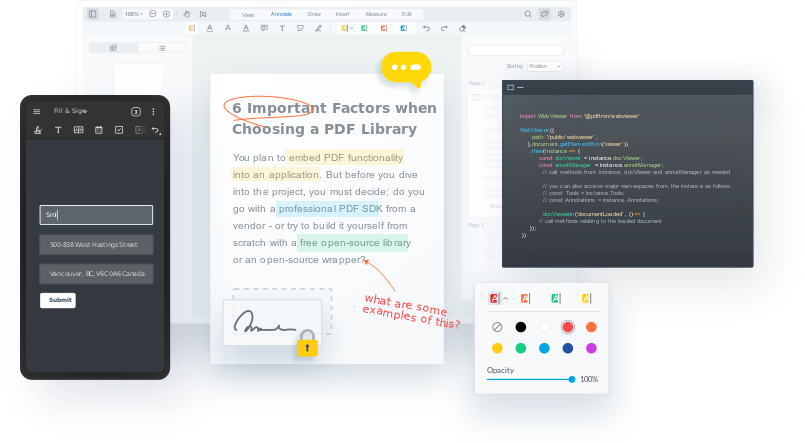
Main Features:
- Merge, split, and create PDF files.
- Convert PDF files to image, such as PNG, JPEG, GIF, BMP, TIFF.
- Extract a Unicode representation of a PDF page and individual text elements with their bounds and font.
- View PDF files in WPF applications.
- Annotate PDF pages with hyperlinks.
- Fill in, flatten, read, and export interactive forms.
- Read, write, and update PDF files.
- Get, create, or edit bookmarks (outlines) and document properties.
- Extract images from PDF files and OCR text from scanned PDFs.
- Add text, images, shapes (paths), form XObjects, content groups, marked content, and format (fill, stroke) to pages and clip the content.
- Encrypt and digitally sign PDF files. Clone or import pages between PDF documents.
- Add watermarks, headers, footers, and viewer preferences to PDF pages.
- Get, create, remove or reorder pages.
Supported PDF versions:
- PDF .Net supports PDF versions 1.2, 1.3, 1.4, 1.5, 1.6, 1.7, PDF/A (all versions), 2.0.
Fonts:
- A lot of core fonts.
- Type 1 fonts.
- TrueType fonts.
- Type 3 fonts.
- CJK fonts.
- Unicode support
Platforms:
- .NET Framework 4.7.2 and higher
- .NET 5 and higher
- .NET Core
OS Support:
- All versions of Windows (32-bit and 64-bit)
- All versions of Linux (with .NET inside / 32-bit and 64-bit)
- Cloud Computing Services: AWS, Azure, Google Cloud, etc.
PDF .Net totally simplifies the development of .NET applications where require to manipulate with PDF documents. Let us say, to provide the method to rotate a page in PDF document, you have add only the reference to the "SautinSoft.Pdf.dll" and write 3-4 C# lines in your application.
If you need any help with code samples, API, prices or antoher issues, please use our WebChat, Teams, Email, Phones:
- +46 812111486 (Sales)
- Teams: sautinsoft.support
- Email: support@sautinsoft.com