How to convert Excel to PDF and set custom area in C# and .NET
Processing and preparing reporting documents is an important part of business application development. A particularly common task is converting Excel spreadsheets to more universal formats, such as PDF, for information exchange, archiving, or secure data distribution. This raises the question: how can we automate the Excel to PDF conversion process, taking into account specific document areas, using C# and .NET?
One solution is to use the Excel to PDF .NET from SautinSoft library – a powerful tool for converting Excel files with high accuracy and flexibility.
Such code can be used in:
- Corporate reporting systems: automatic preparation of statements, balance sheets, or analytical reports.
- Integration with ERP systems: data export for further archiving.
- Educational platforms: automatic generation of template reporting documents.
- Accounting and finance: preparation of financial documents from a specific area to prevent leaks.
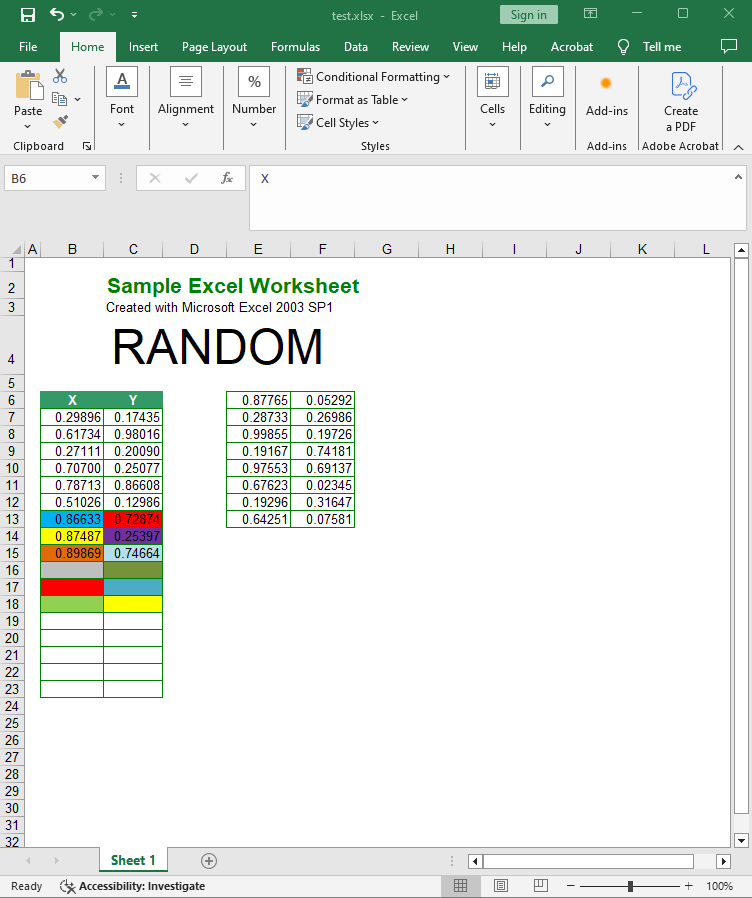
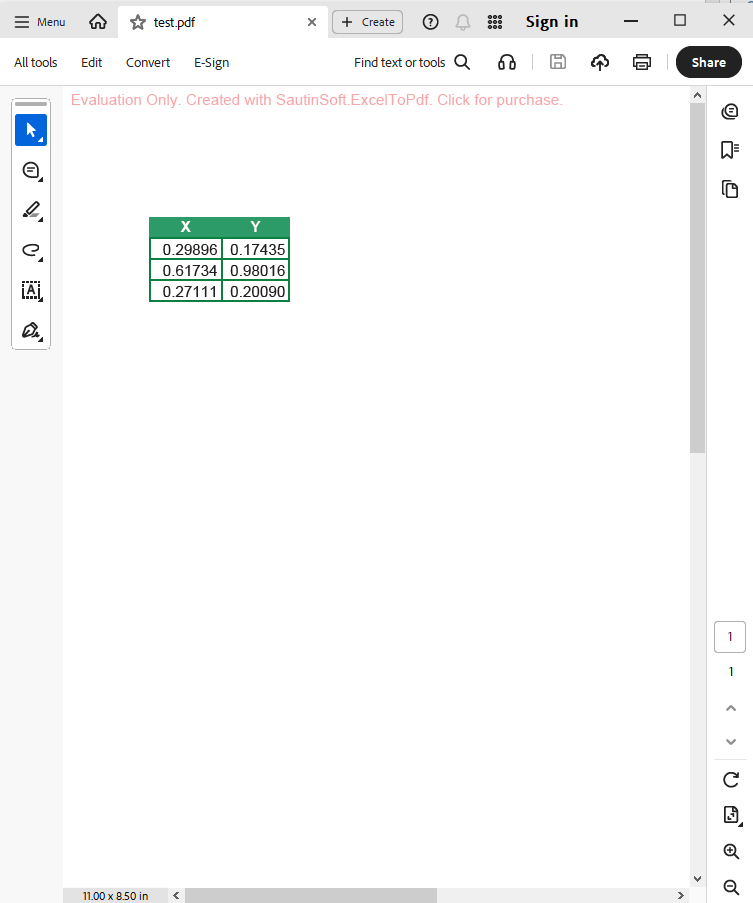
Let's look at a practical example. Let's say you have an Excel file and need to convert it to PDF, including only a specific range of cells or pages. This code becomes a valuable tool in the arsenal of a developer implementing enterprise document management solutions.
Input file:
Output result:
Complete code
 GitHub
using System;
using System.IO;
using SautinSoft;
namespace Sample
{
class Sample
{
static void Main(string[] args)
{
// Set custom area to convert.
ExcelToPdf x = new ExcelToPdf();
x.PageStyle.PageSize.Letter();
// Set PDF as output format.
x.OutputFormat = SautinSoft.ExcelToPdf.eOutputFormat.Pdf;
// Let's convert only rectangle from "B6" to "C9" on sheet 1.
x.Sheets.PrintArea.Add("B6", "C9", new int[]{1});
string excelFile = Path.GetFullPath(@"..\..\..\test.xlsx");
string pdfFile = Path.ChangeExtension(excelFile, ".pdf"); ;
try
{
x.ConvertFile(excelFile, pdfFile);
System.Diagnostics.Process.Start(new System.Diagnostics.ProcessStartInfo(pdfFile) { UseShellExecute = true });
}
catch (Exception ex)
{
Console.WriteLine(ex.Message);
Console.ReadLine();
}
}
}
}
Imports System
Imports System.IO
Imports SautinSoft

Module Sample

    Sub Main()
        ' Set custom area to convert.
        Dim x As New ExcelToPdf()
        x.PageStyle.PageSize.Letter()

        ' Set PDF as output format.
        x.OutputFormat = SautinSoft.ExcelToPdf.eOutputFormat.Pdf

        ' Let's convert only rectangle from "B6" to "C9" on sheet 1.
        x.Sheets.PrintArea.Add("B6", "C9", New Integer() {1})

        Dim excelFile As String = Path.GetFullPath("..\..\..\test.xlsx")
        Dim pdfFile As String = Path.ChangeExtension(excelFile, ".pdf")

        Try
            x.ConvertFile(excelFile, pdfFile)
            System.Diagnostics.Process.Start(New System.Diagnostics.ProcessStartInfo(pdfFile) With {.UseShellExecute = True})
        Catch ex As Exception
            Console.WriteLine(ex.Message)
            Console.ReadLine()
        End Try
    End Sub
End Module
If you need a new code example or have a question: email us at support@sautinsoft.com or ask at Online Chat (right-bottom corner of this page).